

BIOS 256 Week 7 Genetics and Inheritance
Student Name
Chamberlain University
BIOS-256: Anatomy & Physiology IV with Lab
Prof. Name
Date
Concepts of Gene Expression and Inheritance
In previous discussions, we examined the DNA found within gametes, which are specialized reproductive cells containing 23 haploid chromosomes. These chromosomes play a vital role in ensuring genetic diversity across generations. A central question in genetics is: Why do children resemble their parents, and how are hereditary diseases passed along?
A gene is defined as a specific segment of DNA positioned along a chromosome. Each chromosome, made up of an extended DNA strand, may contain hundreds to thousands of genes. These genes provide coded instructions that enable cells to produce proteins essential for structural, enzymatic, and regulatory functions. Within the nucleus, DNA that is not condensed into chromosomes is collectively referred to as chromatin.
Gametes differ from somatic (body) cells in that they contain only 23 unpaired chromosomes. In contrast, normal body cells possess 23 homologous pairs of chromosomes, consisting of 22 pairs of autosomes and one pair of sex chromosomes. Chromosomes differ in size and gene content, as revealed by karyotype studies. Each pair of homologous chromosomes carries the same types of genes at equivalent loci, but these genes may exist in different forms known as alleles.
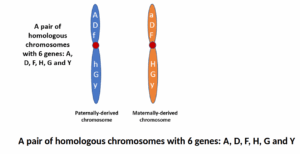
Alleles can be dominant (expressed even if only one copy is present, symbolized by uppercase letters) or recessive (expressed only if two identical copies are present, symbolized by lowercase letters). Because individuals inherit two alleles for each gene (one maternal and one paternal), three allele combinations are possible:
Homozygous dominant (AA)
Homozygous recessive (aa)
Heterozygous (Aa)
The genetic constitution of an individual for a given trait is termed the genotype, while the visible or measurable expression of that trait is known as the phenotype.
Types of Inheritance
Inheritance patterns are influenced by how alleles interact to determine traits.
Dominant and Recessive Inheritance: A dominant allele expresses itself in the phenotype if at least one copy is present. For example, the cleft chin gene follows a dominant-recessive pattern, where the dominant allele (A) produces the cleft chin phenotype in genotypes AA or Aa, while only aa results in a smooth chin.
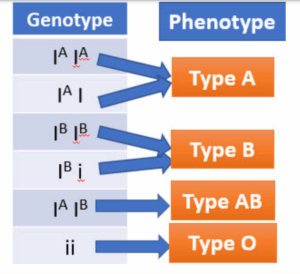
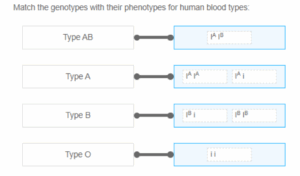
Codominance and Multiple Alleles: In some traits, multiple alleles exist. A prime example is ABO blood typing, determined by three alleles (IA, IB, and i). Both IA and IB alleles are codominant and expressed equally, while i is recessive.
Incomplete Dominance: In this form, heterozygotes express a blended phenotype. For instance, individuals heterozygous for the sickle cell allele display some normal and some sickled red blood cells, resulting in a milder condition compared to homozygous individuals.
Mono- and Polygenic Inheritance
Some traits are controlled by a single gene (monogenic), while many human traits arise from the interaction of multiple genes (polygenic). Environmental influences, such as nutrition and lifestyle, also contribute to how these traits are expressed.
Examples of Traits
| Monogenic Traits | Polygenic Traits |
|---|---|
| Albinism (absence of skin pigment) | Height |
| Huntington’s disease | Skin color |
| Cystic fibrosis | Eye color |
| Polydactyly (extra fingers/toes) | Metabolism |
| Diabetes insipidus | Diabetes mellitus |
| Syndactyly (webbed fingers/toes) | Body shape |
| Widow’s peak (hairline) | Mental illness |
Example: Height is influenced by numerous genes across different chromosomes. While genetics set a baseline, environmental factors like childhood nutrition play a critical role in determining adult height.
Epigenetics
Traditional genetics explains inheritance through DNA sequences, but epigenetics explores how environmental and lifestyle factors influence gene expression without altering the DNA code itself.
Epigenetic mechanisms regulate whether genes are “turned on” or “turned off.” One common process is DNA methylation, in which methyl groups (CH3) attach to DNA, silencing gene activity. Incorrect methylation during gamete formation may disrupt normal development and can even be passed to offspring.
Though humans possess around 30,000 genes, only a few hundred may be active in any given cell type. Epigenetic research provides valuable insight into conditions such as cancer, diabetes, and neurological disorders, highlighting the interaction between environment, lifestyle, and gene regulation.
Sex-Linked Inheritance
Sex chromosomes not only determine biological sex but also carry essential genes. The X chromosome contains hundreds of vital genes unrelated to reproduction, while the Y chromosome has fewer genes, primarily associated with male traits.
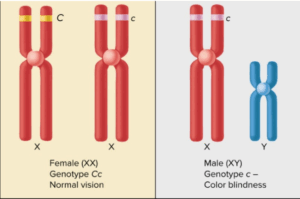
Females (XX): Carry two alleles for each X-linked gene, which may mask recessive disorders.
Males (XY): Possess only one X chromosome, making them hemizygous for X-linked genes and more prone to X-linked recessive disorders.
Examples of X-linked Disorders:
Color blindness
Hemophilia
Duchenne muscular dystrophy
Inheritance Example:
Fathers pass an X chromosome to daughters and a Y chromosome to sons.
Mothers pass an X chromosome to both sons and daughters.
If a mother is a carrier for color blindness (XcX), she has a 50% chance of passing the recessive allele to her sons, who would then express the condition, as they lack a second X chromosome to counter it.
Genetic Testing
Genetic testing helps identify abnormalities both before and after birth.
Prenatal Testing
| Test | Description | Timing | Risk |
|---|---|---|---|
| Ultrasonography | Uses sound waves to visualize fetal development and detect anomalies. | ~8 weeks onward | None |
| Chorionic Villus Sampling (CVS) | Invasive sampling of placental tissue for genetic analysis. | 8–10 weeks | Slight (<2%) |
| Amniocentesis | Extracts amniotic fluid for genetic testing. | 14–20 weeks | Slight (<2%) |
| Maternal Blood Testing | Non-invasive screening of fetal DNA in maternal blood. | 14–15 weeks | None |
Postnatal Testing
Postnatal genetic testing is used when children fail to meet expected developmental milestones. It identifies chromosomal abnormalities, gene deletions, duplications, or translocations. Karyotyping remains a traditional method for chromosomal analysis, though molecular tests (e.g., PCR, microarray, sequencing) provide more detailed results.
Summary
Inheritance is governed by genetic material in the form of DNA, which encodes traits through specific gene combinations. Dominant, recessive, codominant, and incompletely dominant alleles determine how traits appear in offspring. While monogenic traits involve single-gene control, most human features such as height, skin color, and disease susceptibility are polygenic and influenced by environmental factors.
Epigenetics has added a new dimension, revealing that gene expression can be altered by environmental and lifestyle factors without changing DNA sequences. Additionally, sex-linked inheritance patterns explain why males are more frequently affected by X-linked disorders.
Finally, advances in genetic testing provide parents and clinicians with critical insights into potential disorders both before and after birth, enabling informed decisions and early interventions.
References
Griffiths, A. J. F., Wessler, S. R., Carroll, S. B., & Doebley, J. (2020). Introduction to genetic analysis (12th ed.). W. H. Freeman.
Klug, W. S., Cummings, M. R., Spencer, C. A., Palladino, M. A., & Killian, D. J. (2019). Concepts of genetics (12th ed.). Pearson.
BIOS 256 Week 7 Genetics and Inheritance
National Human Genome Research Institute (NHGRI). (2022). Learning about genetics. https://www.genome.gov/