

D024 Mind Map
Student Name
Western Governors University
D024 Professional Presence and Influence
Prof. Name
Date
D024 Mind Map: Improving Patient and Nursing Satisfaction
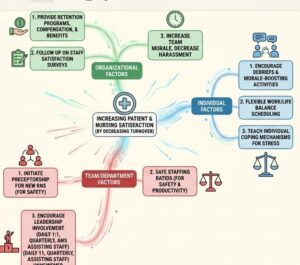
Improving patient and nursing satisfaction while reducing nurse turnover requires coordinated strategies at the organizational, departmental, and individual levels. Healthcare organizations can strengthen nurse retention and improve patient outcomes by creating supportive work environments, maintaining safe staffing practices, engaging nurse leaders, providing professional development opportunities, and promoting work-life balance. These strategies address common contributors to nurse burnout and help create a healthier, more sustainable nursing workforce.
Organizational Strategies for Nurse Retention and Satisfaction
Healthcare organizations play a central role in creating working conditions that support nurse satisfaction and long-term retention. A strong retention strategy should address compensation, benefits, professional development, recognition, and opportunities for career advancement. Competitive wages and comprehensive benefits can help organizations attract and retain qualified nurses, while clear career pathways give nurses opportunities to develop their skills and progress professionally.
Leadership communication is equally important. Organizations can build trust by regularly collecting feedback through employee satisfaction surveys, focus groups, and other communication channels. However, collecting feedback is most effective when leaders also communicate how concerns are being addressed. When nurses see meaningful changes based on their input, they may feel more valued and connected to the organization.
A positive workplace culture is another important component of nurse satisfaction. Healthcare organizations should promote respectful communication, teamwork, psychological safety, and professional accountability. Addressing workplace incivility, bullying, and harassment promptly can help create an environment where nurses feel safe speaking up and collaborating with colleagues.
Department-Level Strategies to Support Nurses
The conditions within an individual nursing unit can have a direct effect on workload, stress, teamwork, and job satisfaction. Nurse managers and department leaders should therefore focus on practical interventions that improve daily clinical operations.
Safe and appropriate staffing is particularly important. Staffing plans should consider patient acuity, nurse experience, workload, skill mix, and the complexity of care rather than relying solely on a fixed nurse-to-patient ratio. Adequate staffing can help nurses provide timely care while reducing excessive workload and fatigue.
Departments can also strengthen support for new nurses through structured onboarding and preceptorship programs. A well-designed preceptorship program pairs new nurses with experienced staff who can provide clinical guidance, feedback, and encouragement during the transition into practice. This support can improve confidence and help new nurses become integrated into the clinical team.
Nurse managers should also maintain a visible presence on the unit. Regular rounding, staff check-ins, one-on-one conversations, and timely responses to workload concerns can help leaders identify problems before they contribute to dissatisfaction or turnover. When appropriate, leaders can also assist with operational challenges during periods of high demand.
Individual Strategies for Preventing Nurse Burnout
Although organizational support is essential, individual well-being also contributes to nursing satisfaction and resilience. Nurses working in high-pressure environments benefit from opportunities to discuss challenging experiences and connect with colleagues.
Team-building activities, peer support, and informal debriefings after stressful clinical events can strengthen professional relationships. These activities can help nurses feel less isolated and encourage a culture in which seeking support is viewed as a normal part of professional practice.
Stress-management strategies can also help nurses manage the demands of clinical practice. Nurses may use techniques such as adequate rest, physical activity, mindfulness, healthy social connections, and appropriate use of employee wellness resources. These individual strategies should complement—not replace—organizational efforts to address excessive workloads or unsafe working conditions.
Work-Life Balance and Flexible Scheduling
Work-life balance is an important consideration for nurse satisfaction and retention. Traditional scheduling models can make it difficult for nurses to manage family responsibilities, education, personal commitments, and recovery time between shifts.
Where operationally feasible, healthcare organizations can consider flexible scheduling approaches such as self-scheduling, predictable schedules, shift-swapping policies, or other scheduling options that provide nurses with greater control over their work patterns. Greater scheduling flexibility can support employee well-being while helping organizations address retention challenges.
Leadership Engagement and Professional Development
Effective nursing leadership can influence both employee experiences and the quality of the work environment. Nurse leaders should communicate expectations clearly, recognize staff contributions, provide constructive feedback, and involve nurses in decisions that affect clinical practice.
Professional development opportunities can further strengthen engagement. Continuing education, mentoring, leadership development, specialty training, and career advancement programs allow nurses to expand their knowledge and pursue long-term professional goals.
When nurses have opportunities to participate in practice improvement and organizational decision-making, they may also develop a stronger sense of professional ownership. Shared decision-making can help organizations incorporate frontline clinical knowledge into policies and workflow improvements.
Key Takeaways from the D024 Mind Map
The D024 mind map demonstrates that improving nursing and patient satisfaction requires interventions across multiple levels rather than relying on a single solution. Healthcare organizations can focus on:
Organizational level: Competitive compensation, benefits, career advancement, feedback systems, and a respectful workplace culture.
Departmental level: Appropriate staffing, effective onboarding, preceptorship, leadership visibility, and strong teamwork.
Individual level: Stress management, peer support, debriefing, healthy coping strategies, and work-life balance.
Leadership level: Clear communication, recognition, shared decision-making, professional development, and responsive management.
Together, these approaches can contribute to a more supportive nursing environment, strengthen workforce retention, and support safer, higher-quality patient care.
References
American Nurses Association. (2020). Nurse staffing and patient care. https://www.nursingworld.org/practice-policy/nurse-staffing/
Buchan, J., Catton, H., & Shaffer, F. A. (2021). Sustain and retain in 2022 and beyond: The global nursing workforce and the COVID-19 pandemic. International Council of Nurses. https://www.icn.ch/publications/sustain-and-retain-2022-and-beyond
D024 Mind Map
Drennan, V. M., & Ross, F. (2019). Global nurse shortages and nurse migration. British Medical Bulletin, 130(1), 55–67. https://doi.org/10.1093/bmb/ldz014